Showing posts with label American War for Independence. Show all posts

Sunday, March 6, 2022

Illustrations of Officers' Servants 1755-1783

Officers in the 18th Century were often attended by servants, and their dress is a fascinating study.  All images are contemporary 18th Century paintings with information where applicable.  Clicking on an image will enlarge it.

1752 "William Kerr, 4th Marquis of Lothian" by David Morier.

This Marquis of Lothian held commissions as Colonel of the 24th Regiment of Foot and as Colonel of the 11th Dragoons.  He is wearing the uniform of the 24th Foot.  What is of interest to this discussion is the young man just to the left of the horse.  He wears a short white coat with white breeches and stockings.  Underneath the coat is a blue waistcoat (presumably) and very unusual yellow garment.  The yellow garment could be a waistcoat but it has fringe at the ends, along with gold embroidery.  It is also possible that it is a type of apron instead.  His cap is of a type similar to that worn by dragoon musicians.  It bears a sun in splendor under a crown, and has white scrollwork on either side and is trimmed with yellow feathers and a black plume.  The young fellow carries a stick with a silver head and not an instrument--an odd omission if he is intended to depict a member of the regimental band.


1780 "George Washington" by John Trumbull.  

In this painting, George's horse is held by a servant, who is possibly William "Billy" Lee.  He wears a red turban with a red plume.  His jacket is dark blue with red cuffs and his waistcoat is red.  Unfortunately, the large horse obscures the rest of the detail.  It is fairly likely, however, that his breeches and stockings are dark as well.


1781: "Marquis de Lafayette" by Jean-Baptiste LePaon.  
The other person is often identified as James Armistead Lafayette, for no discernible reason.  He is more likely a local individual assigned to serve Lafayette in a personal capacity, rather than an espionage capacity.  He wears a hussar-inspired uniform, with high tan boots, tight red pants, and a silver and red barrel sash.  His jacket is red with green cuffs and silver lace, with a black hat decorated with red, white, and green plumes.  He is equipped with a green cloak, a sword, and another crossbelt, the purpose of which is unknown.


1781: "Death of Major Peirson at the Battle of Jersey".  Perhaps the most famous illustration of an officer's servant shows the servant of Major Peirson firing away doggedly at the onrushing French troops. He wears a short navy blue jacket with yellowish cuffs and collar and silver epaulette.  His waistcoat (two rows of buttons) and breeches are yellowish-tan. Grey stockings and black shoes cover his legs.  He wears a yellow and blue striped sash and a black hat with yellow, blue, and black plumes.

1782: "The Earl of Aldborough reviewing volunteers" by Francis Wheatley.  At least one servant is pictured, sitting behind the center carriage.  He wears a white turban, blue jacket with white collar, adorned with an silver epaulette and silver-laced buttonholes, buff breeches, white stockings and brown shoes.  The epaulette, setting, and general similarity to other officers' servants' uniforms suggests that he also performs this duty.


Wednesday, September 11, 2019

Battle of Brandywine Gallery

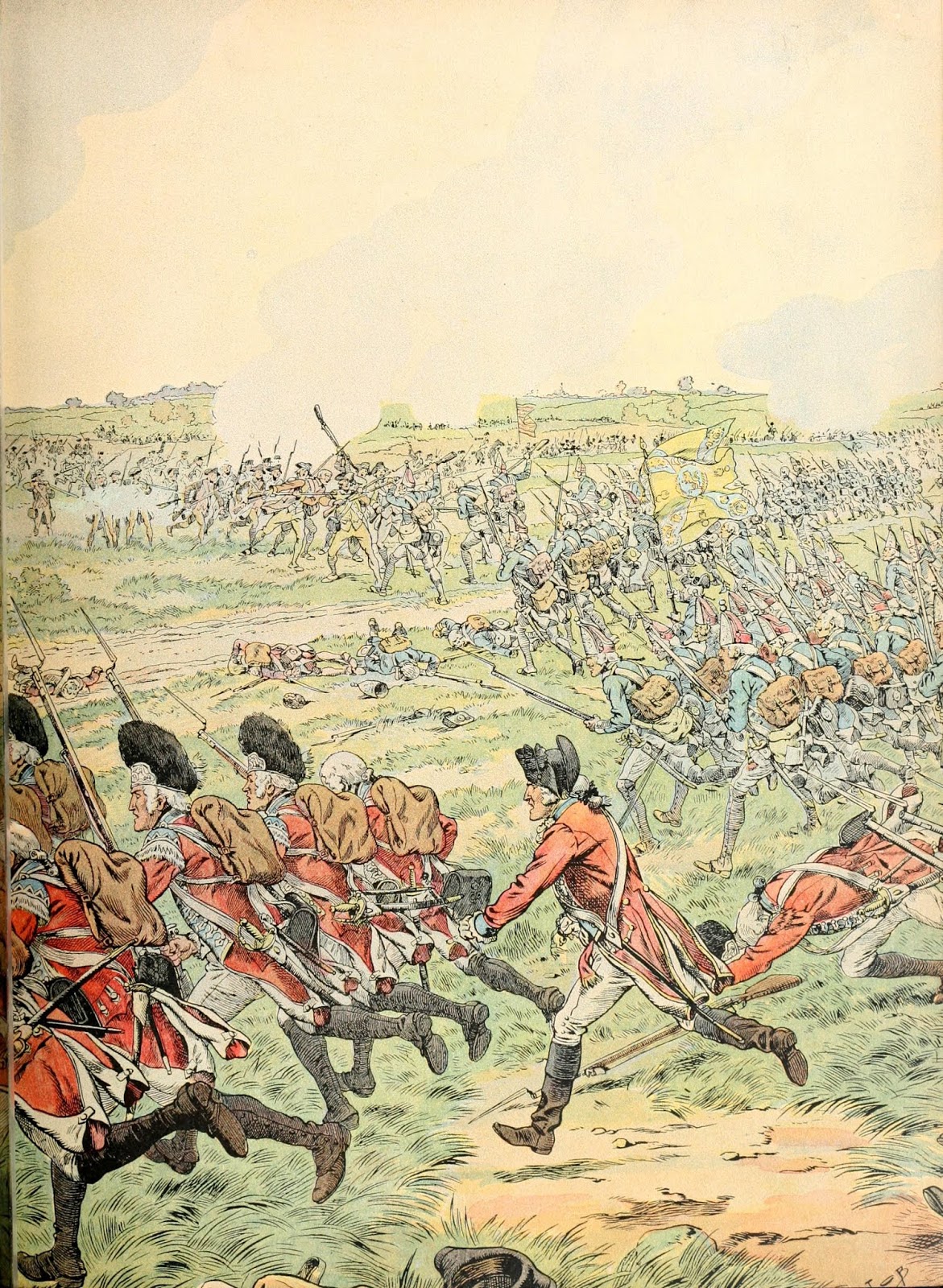
In honor of the 242nd anniversary of the Battle of Brandywine today, I have compiled a gallery of artistic depictions of it.  These are 19th and 20th century illustrations, and usually suffer from  anachronisms.  Please use caution if using them for historical/costume/wargame reference.  However, they are wonderful in capturing a "moment" in time, even if the fine details do not hold up under scrutiny.  Enjoy!

Jacques Onfray de Breville illustrates the attack of the British and Hessian grenadiers.  These two are pieces of the same painting, but as it was an illustration, about 1/4" of the middle was lost in scanning.

F. C. Yohn shows a hastily-constructed line of American troops attempting to stem the tide of the British outflanking attack.

Arthur Becher shows the moment when Washington and his staff received news that the British attack had crumpled the American lines.

As the British surged onward towards victory, a young major general named the Marquis de Lafayette attempted to rally the Americans to halt the British.


In this painting by E. Percy Moran, Lafayette looks like he has single-handedly changed the tide of the battle.  Unfortunately, that was not the case.


Frank E. Schoovener shows Lafayette and a rag-tag group of Americans advancing into the fog of war.  I previously identified this flag as a composite of other flags.  This was erroneous.  The flag is actually copied directly from a surviving artifact.  (Seen at https://www.8thvirginia.com/blog/the-triumphant-return-of-legendary-flag)  This flag was in a private collection until its sale in 2012.  Mr. Schoovener must have had excellent connections to view and copy this flag.


Victor A. Searles' illustration is a bizarre hodge-podge of 18th Century costume, but does capture the impression of a close-quarters melee.

Monday, February 18, 2019

Review of The War for America 1775-83 by Piers Mackesy


I will begin with the end summary first: this is one of the best books about the American Revolution that I have read in a long time.  It provides a very nice counterpoint to Matthew Spring’s With Zeal and With Bayonets Only.  While Spring’s work focused on the nitty-gritty of British tactics and soldiers’ experiences, Mackesy gives a global perspective on the American rebellion.

What is known today as the American Revolution was truly a world war.  Fighting began on Lexington Green in Massachusetts in 1775.  But by the time peace was signed, the war had been waged in Africa, India, the Caribbean, and the seas of Europe.  Though many of these operations are mostly forgotten today, Mackesy fits all of them into the grand strategic plans formed by the leaders in London.  However, events rarely conformed to their plans, and the decisions taken by commanders on the spot (both on land and sea) are also examined.

But this book is not just a sweeping campaign narrative.  It is also the personal story of men tasked with leading their country through a difficult war.  The decisions and personalities of Lord North, Lord Sandwich, and Lord George Germain (not to mention King George III) are just as important to the story as the movements of fleets and armies.  How they each influenced the war is a major part of the book.

The Royal Navy forms a large part of Mackesy's book


To create a book with any kind of biographical content (or even history in general) usually requires digging deep into primary sources, and Mackesy has done so.  Page after page contains footnotes to letters or reports from the War Office, or the Foreign Office, or a host of other sources.  It is impressively researched.  The only minor criticism is that his sources are overwhelmingly British ones.  Few rebel or French, or even Loyalist sources for that matter, are used.  However, his story is that of Great Britain fighting to save her empire, and so probably does not require as many sources from other perspectives.
  
To anyone with an interest in the American Revolution, I would highly recommend this book.  It is a detailed look at the British strategy during the war, so it can be a little slower than other books at some parts.  However, this book’s wealth of information well repays any effort put into it.

5/5 stars.

Friday, October 19, 2018

Yorktown Gallery by Howard Pyle

On this day, Lord Cornwallis surrendered his post at Yorktown to General George Washington and the Comte de Rochambeau.  These illustrations are Howard Pyle's imagining of the events on this climactic battle of the American Revolution.


The first illustration shows George Washington firing the first cannon against the fortifications of Yorktown.

American and French artillerymen continued to bombard the British in Yorktown.  In the second illustration, Washington and his ally Rochambeau inspect Yorktown and plan their next move.

That next move would be an infantry assault against two small fortifications known as redoubts.  The attack was well-planned and succeeded in capturing these two posts in less than thirty minutes.  During these attacks, there was fierce hand-to-hand combat.  Unlike many battles of the 18th Century, officers could cross swords with each other.


On October 19, Cornwallis surrendered to the combined French-American force.  This would be the last major action in the American Revolution.

Monday, November 27, 2017

The Duc de Lauzun in Senegal

Click on image to enlarge
The Duc de Lauzun is primarily remembered for his role in the American Revolution at Yorktown.  There, he commanded a unit of cavalry known as Lauzun's Legion and prevented a breakout attempt by Banastre Tarleton from the post of Gloucester Point.  But before his career in America, Lauzun and his Legion were sent to Africa to seize British trading posts along the Senegal River.  Lauzun captured Fort Saint-Louis from the British in 1779.  In this period drawing from 1784, Lauzun is shown accepting the surrender of Fort Saint-Louis.  Some French infantrymen are shown behind him, possibly the infantry component of his legion.  This drawing is a part of the Library of Congress, and was found at http://www.loc.gov/pictures/item/2017658511/

Tuesday, July 11, 2017

Flag of Armand's Legion (Completely Speculative)

Speculative Armand's Legion flag
Following on my flag reconstructions, here is a completely speculative one for Armand's Legion.  I have never run across any description of this legion's flag, or even if they were issued a flag.  However, we have descriptions/artifacts of the 2nd Continental Light Dragoons, the 3rd Continental, and Pulaski's Legion.


But onto the description of this fictional flag.  I chose a red ground as all three Continental cavalry standards (2nd, 3rd, and Pulaski's Legion) have red as their field.  An owl was chosen as an interesting classical symbol (the owl of Minerva) and also to evoke Armand's service with the Chouans in France.  The motto translates to "Vigilance is the price of Liberty," and the owl seemed to suggest vigilance and wakefulness.  The 13 stars and fleur-de-lis is taken from contemporary drawings of United States flags.


If you would like to deploy your wargame unit of Armand's Legion under this standard, please feel free; however, credit and a link back to this post is appreciated :)
Edit: A reader requested a proper doublesided flag of Armand's flag, and here it is!

If you like our flags, be sure to check out https://www.wargamevault.com/browse/pub/14586/Through-All-Ages-LLC for even more flags by the author, including many free ones!


Wednesday, January 18, 2017

Review of Grace Triumphant by Alicia Willis


While most of my reading focuses on historical nonfiction, I do enjoy a good work of historical fiction—if I can find it. At a recent convention, Schuyler M. of Lady Bibliophile (www.ladybibliophile.blogspot.com) recommended Alicia Willis as an author of historical fiction whom I might enjoy. After looking over all titles written by Alicia Willis, I picked out her novel Grace Triumphant to begin with. Why did I choose this one over any of her others? This was set in my favorite time: the 18th century. When I had finished, I had thoroughly enjoyed the story. It follows three characters and their travels: the squalid slums of London, the high seas (and their scurvy pirates), upper-class English society, and even the English-held island of Jamaica.

The story is written as a parallel narrative between three main characters: Russell Lawrence, a captain of a merchant ship involved in the slave trade, his cabin boy Jack Dunbar, and English high-society lady Elizabeth Grey. The narrative cuts back and forth between these three and their own personal struggles, often allowing the reader to see their personalities, motivations, and thoughts in a way that the other characters cannot. To keep interest (it certainly worked for me!) the narrative will leave one character in deep trouble when it turns to another character. I enjoyed this method of storytelling, and it was accomplished extremely effectively.

Each character faces his own struggles, both internally and externally. Captain Lawrence squares off against pirates, storms, and the myriad dangers of Africa. Jack Dunbar tries desperately to survive as a cabin boy on a tightly-run slave ship. Elizabeth Grey is an English aristocrat with a kindly heart and a treacherous circle of friends.

While the external dangers are myriad, each character’s internal struggles are even harder to conquer. This book allows us to see how their struggles sometimes take place in our own lives. Captain Lawrence tries to make his living in the world and run his ship with justice. Dunbar worries about how he can be a Christian witness among the darkness of slave traders. Miss Grey must choose between standing firm on her principles or receiving love and adoration.

Historical details are generally accurate, with only two minor anachronisms I have found. 
1) The crew of the Barbados, a British merchantman, is equipped with poniards, a thin dagger developed during the Renaissance and generally used as backup in a rapier duel. These are too early (and delicate) for general shipboard use in the 1780s. 


A private of Ferguson's Corps with breechloading rifle
2) Upon seeing a breech-loading firearm in Africa, Jack Dunbar recognizes its mechanism and recalls a tavern patron who bragged about shooting American rebels at Saratoga with one. No British soldier at Saratoga (1777) carried a breechloader; however there were breechloaders at the battle of Brandywine, (also in 1777) carried by Ferguson’s corps of marksmen.  See Don Troiani's painting at https://www.facebook.com/104952196246190/photos/a.104962546245155.8895.104952196246190/884035795004489/?type=3&theater.  Furthermore, Ferguson’s corps was made up of detachments from the regular British army, as is inferred in the book. Rather than labelling this an anachronism, I am inclined to blame Dunbar’s faulty memory, or the length of time this veteran spent at the tavern before telling his story.

However, as stated above, these do not detract from the story—or its historical setting—at all. This book is filled with the 18th century, whether a mutineer dances the hempen jig or a highwayman stalks London’s high society. In addition, I must compliment the author for including yet another historical accuracy. While it would have been easy to blame the slave trade on English traders or New World planters, the role of African (or sometimes Arab) chieftains in kidnapping and selling slaves to the Europeans is laid out here as well. All three were equally guilty of furthering this abominable trade.

As Christians, we often feel that our impact on the world is negligible, if not nonexistent. I struggle with this often. But Grace Triumphant faces this problem squarely, and offers ways to overcome this feeling. Dramatizing the struggle against the English slave trade, the author demonstrates how even one ordinary person’s labors can change others. The two characters who attempt to reform their world are overtaken by events and dominated by the other characters. Yet we see how their efforts are used to help others. I won’t spoil exactly how this happens; you will have to read the book for yourself.

In conclusion: Grace Triumphant is an exciting yarn with important lessons for 21st Century Christians, particularly Christian young people. 4.5/5 stars.
 

Wednesday, December 14, 2016

Free Major John Andre Paper Soldier

I run a business called Through All Ages LLC (www.ThroughAllAges.com).  For Through All Ages, I create historical posters, postcards, and paper soldiers.  Would you like to assemble one of our paper soldiers for free?  Just visit http://www.currclick.com/product/102345/Major-John-Andre-paper-soldier to download a free paper soldier and his base.  This figure is the Adjutant-General of the British Army and spymaster Major John Andre.  His face is copied from a portrait of Major Andre, and his uniform is carefully researched.  The page also includes a short biography of Andre, as well as assembly instructions.

Wednesday, October 19, 2016

Yorktown Paintings by David R. Wagner

On this day in 1781, Lord Cornwallis surrendered his army of 8,000 British, Hessian, and Loyalist troops to Continental General George Washington and French General the Comte de Rochambeau.  Yorktown is regarded as the last major battle in the American Revolution, for while there would still be other battles, Yorktown convinced the British government to come to terms with their rebellious colonies.


Painter David R. Wagner has painted a comprehensive series of paintings, tracing the routes of Rochambeau's French army from their initial encampments at Rhode Island to ultimate victory at Yorktown.  These can be viewed at http://www.davidrwagner.com/revolutionaryrouteseries.htm  With detailed historical research and a wise use of color, I greatly enjoy all of these American Revolution paintings.  Because his "Revolutionary Route Series" contains over 50 paintings, I have spotlighted those that deal specifically with the siege of Yorktown.  All descriptions are from his website.
Sabre Au Clair
The flanking charge of Lauzun's Legion during The Battle of the Hook on October 3, 1781 at Gloucester Point, Virginia.
http://www.davidrwagner.com/va-sabreauclair.htm


Virginia Militia Battle Tarleton
On October 3, 1781, Lauzun's legion clashed with British forces headed by Tarleton. The battle took place across from Yorktown on the Gloucester side of the York River. After a protracted engagement, in which the Virginia Militia were involved, the forces under Tarleton were forced to withdraw. It was a preview of the surrender of Cornwallis just 14 days later, bringing the war to an unofficial end.
http://www.davidrwagner.com/va-virginiamilitia.htm


Night Assault on Redoubt #9
On the night of October 14, 1781, attacks against Redoubt #9 and Redoubt #10 were ordered. The assault on Redoubt #9 was a French undertaking, with American forces assaulting Redoubt #10. The French Royal Deux Ponts and Gatenois Regiments took on the Hessian Erbprinz Regiment. Because it was dark, and both the French and Hessian troops wore dark blue coats, many were killed by "friendly fire" as they could not be easily identified as friend or foe.
http://www.davidrwagner.com/va-nightassaultredoubt9.htm


Assault on Redoubt #10
Although the Rhode Island Regiment was consolidated into a single unit in May 1781, the contingent of black troops was still called the "1st Rhode Island" and were commonly referred to as "Olney's Batallion." After dark on October 14, 1781, three days before the surrender of Cornwallis, the column moved forward in silence, muskets unloaded, bayonets fixed, in good order. Leading were eight pioneers with axes with the forlorn hope to be first through the cleared breach. With one man per company, then Col. Gimete (French officer) with five young officers in advance; next was Olney's Company and then the rest of the force. "When we came under the first of the abattis (logs and brush), the enemy fired a volley of musketry. The British continued to shoot, but aimed high. The pioneers then cut through the abattis. Olney moved past them, climbed the outer wall of the Redoubt, stepped on to the parapet between the two palisades. Twelve of his men followed closley. He called out, "Capt. Olney's company, form here." Six or eight British bayonets pushed at him. Some scaled his fingers, one pierced his thigh, another stabbed him in the abdomen just above the hip bone. Two of his men had loaded their muskets and came to the aid of their Captain, firing at the enemy soldiers attacking him. With this the redcoats ceased their assault; some ran away, some surrendered. The rest of the American force now entered the redoubt without opposition. The redoubt was taken in ten minutes. Lafayette praised very well known personages for their performance in the assault, but made only a cursory reference to Olney -- a situation occuring in all wars where the wrong people get the credit. Afterward, Gimete, the French officer, visited Olney in the hospital to say that Lafayette needed to rectify his omission; but the veteran Continental answered, "Let it go, the day is past." It was eventually brought to Washington's attention and the Rhode Island flag was ordered to be flown above the Redoubt through to the surrender a few days later.
http://www.davidrwagner.com/va-assaultonredoubt10.htm


And the Guns Fell Silent
In October at Yorktown, a young British drummer boy was ordered to the parapet to beat the call for a parley. No one knows the boy's name nor where he stood when the guns fell silent as he began to beat his drum. Behind him followed a British officer waving a white handkerchief, thus signalling, for all practical purposes, the end of the American Revolution.http://www.davidrwagner.com/va-gunsfellsilent.htm

Wednesday, October 5, 2016

Patrick Ferguson at the Battle of Brandywine


Captain Patrick Ferguson
A slim captain dressed in a short green coat slipped through the forest. He looked quickly left and right, visually checking that his corps was in position. They had an important task: spearheading the advance of General Knyphausen across the Brandywine River. Captain Patrick Ferguson concealed himself in the brush and checked that his weapon was ready for action. This was no ordinary musket, but a highly-sophisticated breech-loading rifle. Ferguson held a patent for it and had even demonstrated it before King George III.

The British realized the importance of Ferguson’s rifle, and ordered him to form a unit of riflemen to aid them in their war against the American rebels. 100 men were put into Ferguson’s Riflemen, and since their guns could fire 6 shots a minute, they were a formidable asset to General Knyphausen’s column.

As Ferguson watched the countryside, he noticed two riders come slowly toward his ambush. One was unusually dressed in a hussar uniform, while the other rode a bay horse and wore a large cocked hat. Ferguson ordered three of the best shots in his corps to come and shoot down these officers, but countermanded the order. To deliberately target officers like this was not civilized warfare.

The hussar made a circuit away from Ferguson, but the other came within range. Slipping out of the brush, Ferguson called, ordering him to stop. The rider looked back and slowly continued on his way, heedless of Ferguson’s deadly rifle. Again Ferguson motioned for him to halt, but the rider’s back was turned and he kept on.

What an opportunity! Patrick Ferguson, one of the best marksmen in the British army, could have shot this rider, who was obviously a general officer, in the back. Yet as he fingered the trigger, a thought flashed through his mind. It is not pleasant to shoot an unoffending individual in the back, he mused, especially while this individual is only attempting to do his duty. Ferguson lowered his rifle and the man rode away.

Minutes later, a musket ball slammed into Ferguson’s right elbow. He was helped to the field hospital, where the bullet was extracted. As he was recovering, he told this story to other wounded British officers. One of the surgeons, who had been attending the wounded Americans, heard it.   He informed Ferguson that the officer he had earlier refused to shoot was none other than the rebel commander-in-chief, General George Washington.


God’s hand of Providence had clearly kept George Washington safe at this battle of Brandywine.
"Washington's Encounter Along the Brandywine"
Painting by Pamela Patrick White.
Visit http://www.whitehistoricart.com/ppatrickwhite/Pages/WashingtonBrandywine.htm


Ferguson's own account of the battle is as follows:


A member of Ferguson's Rifles, as illustrated by Don Troiani
"We had not lain long...when a rebel officer, remarkable by a hussar dress, passed towards our army within a hundred yards of my right flank, not perceiving us.  He was followed by another, dressed in dark green or blue, mounted on a bay horse, with a remarkably large cocked hat.
I ordered three good shots to steal near...and fire at them, but the idea disgusted me.  I recalled the order.  The hussar in returning made a circuit, but the other passed again within a hundred yards of us, upon which I advanced from the woods towards him.
On my calling, he stopped, but after looking at me, proceeded.  I again drew his attention and made signs to stop but he slowly continued his way.  As I was within that distance at which in the quickest firing I could have lodged half-a-dozen of balls in or about him before he was out of my reach, I had only to determine.  But it was not pleasant to fire at the back of an unoffending individual, who was acquitting himself very coolly of his duty, so I let him alone.
The day after, I had been telling this story to some wounded officers who lay in the same room with me, when one of our surgeons, who had been dressing the wounded rebel officers, came in and told us they had been informing him that General Washington was all the morning with the light troops and only attended by a French Officer in a hussar dress, he himself dressed and mounted in every point as above described.  I am not sorry that I did not know at the time who it was."

Monday, September 26, 2016

Unmerited: Movie Review


Official Description: “Two brothers estranged after a tragic accident, meet unexpectedly years later.”

The concept for this movie is taken from Ezekiel 16:64 "That thou mayest remember, and be confounded, and never open thy mouth any more because of thy shame, when I am pacified toward thee for all that thou hast done, saith the Lord GOD."

My Review: (beware, spoilers ahead)

The American Revolution has broken out and Charles Rosse is serving as a Continental private. When his unit engages in battle against the British, Charles’ comrade is shot and killed. This stirs painful memories for Charles, as he remembers that his younger brother Henry fell from a ship’s rigging and died.

With the end of the American Revolution, Charles Rosse returns to his home town. He stops at the harbor, looking at a merchant ship being unloaded. A gentleman sits nearby, tallying the stores. The gentleman looks at Charles, and Charles moves away. Despite his service in the war, no one greets him kindly. Townsfolk pass on their way, and the landlady refuses to rent him a room because he can only pay in worthless Continental paper dollars. Disconsolately, Charles walks down the street until he is accosted by a young girl about 9 years old. She cheerfully informs Charles that her father would like to see him. After some hesitation, Charles decides to follow her.

Much to his surprise, the girl’s father is familiar—in fact, he is none other than Charles’ long-dead brother Henry! The accident was not fatal, even though Henry was crippled in one leg. For 15 years Charles had not seen Henry, because he fled from his family. Charles is certain that his father despises him, until Henry informs him that their father died, wishing for Charles’ return.


Reluctantly, Charles informs his brother that the accident on the rigging was deliberate. Charles felt slighted because of his younger brother, so he deliberately caused Henry to fall from the rigging, breaking his leg. Yet even with this news, Henry states that he forgives his brother. But Charles does not believe him and prepares to wander away to another town. As Charles makes ready to exit the graveyard, Henry calls after him “I still forgive you.” This finally convinces Charles that Henry still loves him. He turns back and the two brothers are reunited.  Henry owns a merchant ship (he was the gentleman tallying stores) and he offers Charles a position as skipper.
(Spoiler warning ends.)


My Thoughts

This is a little gem of a movie. Less than 10 minutes long, it packs both an important message and impressive visual shots. Its message of forgiveness and love in the face of suffering is one that we should never tire of (see also my Lessons Learned from the Noah Conference at
http://defendingthelegacy.blogspot.com/2016/09/lessons-learned-from-noah-conference.html)

As well as an important message, this movie also contains lavish visuals. From the colonial town that Charles wanders through, to the battle between companies of Continentals and Redcoats, this movie’s sets and costumes are top-notch.

My conclusion: Impressive scenery, sets, and a ship combined with a powerful story of love and forgiveness make this movie worth watching. 5/5 stars.

See it here!


Thursday, September 8, 2016

Flags of Yorktown (with thanks to James Peale)

Click on the picture to expand it
and view the details

Paintings by eyewitness artists give us a priceless view into the world of the American Revolution. The painting shown here is a portrait of George Washington at Yorktown, painted by James Peale. James Peale was an artist just like his older brother Charles Willson Peale.
 
The painting under analysis right now is obviously based on Charles Willson Peale’s portrait entitled “George Washington at Princeton.” But this painting depicts Washington’s greater triumph at Yorktown.
 
Its details are extremely valuable. No fewer than 7 flags are visible in this painting. Working from bottom left to top right:
 
1. The King’s Color of the 76th Highlanders, crumpled in the bottom left of the painting. Each regiment carried a King’s color which was a Union Jack with the regiment’s number in the center. Under magnification (click the picture to enlarge) the script “Reg 76” can be clearly seen. This flag also offers a magnificent view of the gold-and-crimson mixed cords which were tied around the top of British regimental flagpoles.


2. The Regimental Color of the 76th Highlanders, which is green and draped across the cannon. A regimental color was the same color as a regiment’s cuffs and lapels. It contained a small Union Jack in the upper left canton and the number of the regiment in the center. As the 76th Highlanders were the only British regiment at Yorktown with green cuffs and lapels, this flag belongs to them.
 
 
3. This flag is an Ansbach-Bayreuth regimental color, draped across the cannon, next to the 76th regimental color. There were two Ansbach-Bayreuth regiments at Yorktown, and they surrendered ten very similar flags. This position shows the reverse of the flag, with a red eagle on it. For a thorough discussion of these flags, visit https://archive.org/stream/yorktownsurrende001989#page/36/mode/2up
A photograph of a surviving Ansbach-Bayreuth flag
4. This flag is another Ansbach-Bayreuth regimental color, folded on the ground. This is the obverse of the Ansbach-Bayreuth flag, with the Margrave’s initials surmounted by a crown. Also see entry 3, above.
 
5. Hiding behind the Ansbach-Bayreuth color draped on the cannon is a King’s color of an unknown regiment. No regimental distinctions are visible.
 
6. Above the 3rd Continental Light Dragoon (holding Washington's horse) is an American flag with thirteen white stars in a circle on a blue canton. Mysteriously, this flag appears to have no red stripes, but only a field of white. Why is this? My conjecture is that it is a regimental standard for a Continental regiment with white facings, and that the unit’s motto/distinction would be in the center. This flag also appears to have a blue cord wrapped just below the spear point.


Each flag annotated with its identification (if known)

7. The last flag, next to the American flag, is obviously a French flag. The three fleurs-de-lys proclaim its nationality. It is decorated with a golden cord, but oddly is lacking the white cravate which was normally placed on the flag as well. A minor mystery encircles this flag as well, for it is unlike any French flag known to have been at Yorktown. It most closely resembles a “colonel’s” flag, which was white with a white cross of Saint-Denis (+ shape) overall, but the arrangement of the fleur-de-lys suggests that it bears the white cross of Saint Andrew (x shape). Since it matches none of the French flags currently known, could it be a colonel’s color of Lauzun’s Legion. Lauzun’s Legion sailed to America accompanied by its colonel, the Duc de Lauzun, so perhaps this identification is possible. An alternate theory is that it is a “national” flag of France.

This concludes our look at the flags of James Peale’s portrait of Washington at Yorktown. Of the seven flags visible, the details of four (two of the 76th Highlanders and two of the Ansbach-Bayreuth regiments) can be substantiated with other evidence. Since this is the case, there seems to be no reason to deny the authenticity or accuracy of the other three flags in this painting.  I eagerly await more analysis of the other three flags.

Thursday, July 14, 2016

Did Cornwallis "Arrogantly Underestimate" Lafayette in the 1781 Virginia Campaign?

“He invaded Virginia but arrogantly underestimated the 23-year old Marquis de Lafayette, wasting valuable time by attempting to engage Lafayette’s forces in pitched battle. Failing to do so, he retreated to Yorktown…”

This quotation describes the 1781 Virginia campaign which ended in the surrender of Lord Cornwallis at Yorktown. Obviously, the authors are not impressed with Cornwallis’ record in Virginia. He is alternately accused of not regarding Lafayette’s army as a threat (underestimating), and then overestimating its effectiveness (wasting valuable time to rid himself of it) in a single sentence! These two charges are contradictory, but a this scathing critique of George III’s best fighting general justified?

In June of 1781, Lord Cornwallis had arrived in Virginia from South Carolina. Cornwallis had about 7,000 British and Hessian soldiers in his army. (1) Many of Cornwallis’ British soldiers were the elite of the British army in North America. The 23rd Royal Welsh Fusiliers, the 33rd Regiment, the 1st and 2nd Battalions of Light Infantry, and Banastre Tarleton’s British Legion were all fearsome troops. Each of these units had gained battlefield victories, despite being outnumbered by the rebels. These were true veterans. But the rest of Cornwallis’ army in Virginia was not comprised of second-rate troops. The 76th and 80th Regiments, though not as experienced in battle, would gain a victory at the Battle of Green Spring.

While Cornwallis’ army numbered 7,000 trained soldiers, the Marquis de Lafayette (the American commander in Virginia) had about 5,000. Some of these were excellent troops, such as his three Light Infantry battalions, as well as the three Pennsylvania regiments. But almost 2,000 men of his army were poorly-trained Virginia Continental or militia soldiers. (2)

In Virginia, then, Cornwallis enjoyed both superiority of numbers and superiority of quality against Lafayette. He used this to carry out two lightning-fast raids against Charlottetown and Point of Fork. Lafayette was not able to counter these raids, and Cornwallis could be pardoned had he not regarded Lafayette’s army as a threat. But Cornwallis was too shrewd to do that.

Learning that Lafayette was following him towards the Virginia coastline, he set an ambush for him at Green Spring. In the ensuing battle, Lafayette’s force barely managed to escape defeat, thanks to Lafayette’s caution and timely darkness. The battle took place on July 6. Since Cornwallis fought and won against Lafayette, how can he be accused of failing to engage him in battle?

While Cornwallis did not arrogantly underestimate Lafayette, did he waste “valuable time” chasing him around Virginia? The assumption seems to be that had Cornwallis entrenched at Yorktown earlier, his fortifications would be more complete, the siege would have been slower, General Clinton would have sent British reinforcements from New York City, and Yorktown might not have been captured by Washington and Rochambeau.

Firstly, this is a precarious chain of events. There are no guarantees that more time entrenching would have changed the outcome of the battle. Had Clinton sent British reinforcements, they would likely have been defeated by the powerful fleet of Admiral de Grasse, prowling in the Chesapeake Bay with his French fleet.

Secondly, Cornwallis was hampered by contradictory orders from his superior, General Clinton. This resulted in a waste of time in marches and counter-marches around Virginia. Clinton and Cornwallis had different ideas on how to win the war. Clinton believed in fortifying key positions; Cornwallis preferred finding and defeating rebel armies.

In conclusion: did Cornwallis’ character faults doom him to defeat at Yorktown? Certainly not. Cornwallis was a wise general—probably the best Britain had in the American Revolution. His actions in the Virginia campaign against Lafayette were wise, not hampered by arrogant underestimation.


For more about the 1781 Campaign and the siege of Yorktown, check out my lecture: “A Providential View of the Battle of Yorktown.” It is available at: http://www.dovecds.com/shop/inch/069-jachim-jordan-a-providential-view-of-the-battle-of-yorktown-funshop/.  While I gave the lecture, I do not make any money off its sale.


Notes:
(1) Number of Cornwallis' troops taken from  pg. 37 and pg. 76 of Yorktown 1781 by Brendan Morrissey (Oxford: Osprey, 1997). It should be noted here that Cornwallis only had about 4,500 of these troops at the battle of Green Spring; the rest garrisoned points in Virginia.

(2) Lafayette's numbers are taken from pg. 34 and pg. 37 of Yorktown 1781 by Brendan Morrissey (Oxford: Osprey, 1997). Previously, Lafayette's forces had been much smaller; he entered Virginia in the spring of 1781 with about 1,200 Continentals.