Monday, September 24, 2012

Chevalier de Bernetz

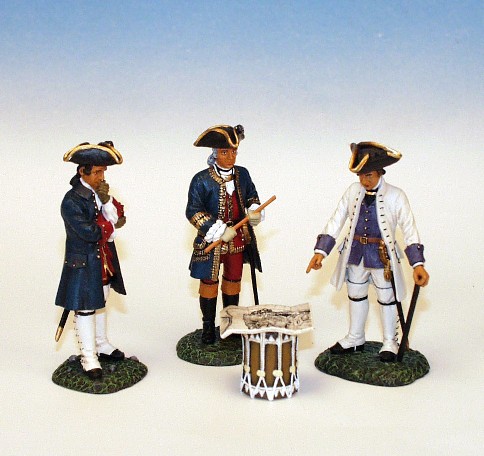
I enjoy collecting two things: books and military miniatures (a.k.a. toy soldiers).  My collection of soldiers is about the French and Indian War and made by two manufacturers: Frontline Figures and John Jenkins Designs.  Three soldiers in my collection belong to Frontline Figures set FPW.1, which contains General Montcalm and two senior officers.

One of the officers is an engineer or artillery officer (from 1755 to 1759, artillery and engineers wore the same uniform).  The other one is a senior officer of the French regular regiment Royal-Roussillon, likely Chevalier de Bernetz.

"Of the Chevalier de Bernetz, Lieutenant-Colonel in command of the Royal-Roussillon, Montcalm said: 'With courage worthy of his extraction, this officer is very intelligent and well-placed at the head of a corps.'"--pg. 27, Montcalm at the Battle of Carillon by Maurice Sautai


 As a senior officer, and a Chevalier of Saint-Louis at that, I (1) trimmed his waistcoat with gold lace; (2) trimmed his coat and coat pockets with the same; (3) painted the cockade in the hat white; and (4) added the Cross of Saint-Louis on his coat.

Thursday, September 13, 2012

French and Indian War Gallery by Howard Pyle

Howard Pyle was one of the most important American illustrators during the late 1800s-early 1900s.  He wrote and illustrated Men of Iron and Robin Hood, among other projects.  He also influeced one of my personal favorite artists, N. C. Wyeth.  Pyle was commissioned several different times to paint scenes from the French and Indian War (1754-1763).  Note: all pictures included here are, as far as I know, in the public domain.  Pyle died in 1911.

This collection opens with young Major Washington and his dejected troops trudging back to Virginia after their defeat at Fort Necessity.  Fort Necessity only opened the war, however, and soon General Braddock and the 44th and 48th were sent to expel the French.  On July 9, 1755, Braddock's troops, led by the grenadiers, collided with the French and Indians.  In a two-hour long battle, Braddock was mortally wounded and taken from the battlefield in a cart.  He died and was buried four days later.

The French had defeated Braddock, but the days of their empire were numbered.  In 1758, General Jeffrey Amherst captured the fortress of Louisbourg, key to the Saint-Lawrence.  In this painting, an officer of the Volontaires-Etrangers negotiates with the British officers regarding the surrender of Louisbourg.

One year later, General James Wolfe would besiege Quebec, defended by General Marquis de Montcalm.  On September 13, the two generals and their armies would fight on the Plains of Abraham.  Wolfe died before the battle had finished, but the wounded Montcalm lingered until September 14.  In this painting, Montcalm rides into the city through the Saint-Louis gate.  A crowd of frantic civilians swarms around him and the remnants of the French force.  But Montcalm's arm is up, as though to still the tumult.  "It is nothing, it is nothing, do not cry for me, my good friends."


Monday, September 10, 2012

James II on the Monmouth Rebellion

In 1685, Charles II died and his brother James succeeded him to the throne as James II.  James Scott, Duke of Monmouth was an illegitimate son of Charles and launched a rebellion in the same year to gain the throne for himself.  At Sedgemoor, his army was crushed and dispersed.  The Duke himself would be executed.  Here are James II's Meditations on the Battle of Sedgemoor:

Upon the defeat of Monmouth and Argyll, and suppressing those rebellions.
"Not unto us, O Lord, but to thy own blessed Name give all the glory." Awake my soul, and speedily preserve thy richest sacrifice of humble praise. Awake, and summon all thy thoughts, to make haste and adore thy great preserver and redeemer. Arise, my soul, to thee these joys belong; arise and advance thyself on high, and leave here below all earthly thoughts, and fly away with the wings of the spirit; fly to that glorious land of promise, and gladly salute those heavenly regions. Let us now consider, O Lord our God, let us thankfully remember what thou art to us. Thou art the great beginning of our nature, and glorious end of all our actions; thou art the overflowing source from whence we spring, and the immense ocean into which we tend; thou art the free bestower of all we possess, and faithful promiser of all we hope; thou art the strong sustainer of our lives, and ready deliverer from all our enemies. When we have applied our utmost cares, and used all the diligence that lies in our power, what can we do, but look up to thee, and second our endeavours with prayers for thy blessing! When we have implored thy gracious mercy, and offered thee our dearest sacrifice to obtain it, what can we do, but submit our hopes, and expect the issue from thy free goodness, we know, and thou thyself has taught us. "Unless thou defendest the city, the guard watches in vain." We know, and our own experience tells us, unless thou reachest forth thy hand, we are presently in danger of sinking. Sometimes, O Lord, thy all-wise Providence seems to sleep, and permits the storm to grow high and loud; yet never fails to relieve thy servants who faithfully call upon thee in the day of trouble. "I will extol thee, O Lord, for thou hast lifted me up, and hast not made my foes to rejoice over me. Now shall my head be lifted up above my enemies round about me; therefore will I offer in his tabernacle sacrifices of joy; yea I will sing praises unto the Lord."
"The Lord is my strength and my shield; my heart trusteth in him, and I am helped. Therefore with my song will I glorify and praise him; the Lord is the saving strength of his anointed. When the wicked, even mine enemies and my foes came upon me to eat up my flesh, they stumbled and fell. For the king trusteth in the Lord, and through the mercies of the Most High he shall not be moved."
Impute not to me, O Lord, the blood of my subjects, which with infinite unwillingness and grief hath been shed by me in my just and necessary defence, but wash me with that precious Blood which hath been shed for me by my great Peace-maker, Jesus Christ.

Quotation from http://www.jacobite.ca/documents/1692meditations.htm, a highly recommended website, containing over 100 original documents.

Wednesday, September 5, 2012

Empress Anne of Russia

"Therefore if thine enemy hunger, feed him; if he thirst, give him drink; for in so doing thou shalt heap coals of fire on his head."--Romans 12:20

Anne, Empress of Russia was born on February 7, 1693.  She married Frederick Wilhelm on November 11, 1710 and was crowned Empress of Russia on April 28, 1730.  Anne was not a model empress, being capricious, as well as rejecting the "Conditions", an early form of constitution to limit the monarch. 

In 1733, the War of the Polish Succession broke out.  France backed King Stanislas I while Austria and Russia supported Augustus III.  Comte de Plelo organized a French expedition to relieve Stanislas who was besieged in Danzig.  In a daring attack, Plelo was killed and his small army dispersed.  The Russians captured the remainer of the French expedition and shipped them to St. Petersburg.  In honor of her victory, Anne held a fete at the palace, which she compelled the French to attend:
"The Empress, however, seemed to have treated them with kindness otherwise.  On that same occasion at the palace, the officers were even allowed to wear their swords in Her Majesty's presence, and they were entertained as guests.  The Empress also gave to every common soldier a coat lined with sheep-skin, and every officer one lined with fox-skin, when the weather turned cold."--pg. 30, War of the Polish Succession by Vajiravudh, Prince of Siam

R. Nisbet Bain adds: "'It must be confessed,' wrote Mr. Rondeau some time later, 'that Her Majesty has been very kind to the three French regiments, most of whom would have perished here of cold if the Tsaritsa had not been so good to give every common soldier a greatcoat lined with sheepskin, and to every officer one lined with fine foxskin.'"--pg. 225, The Pupils of Peter the Great by R. Nisbet Bain (quotation from Rondeau: Dispatches)
This illustration by the author depicts the French officers and Empress Anne (center).  On the dais (raised platform) stands a nobleman and the elite Grenadier-Guards.  The captain of the Grenadier-Guards wears a green waistcoat, while the two soldiers wear red.  Comte de la Motte is bowing to the Empress and the officers stand behind him, in the uniforms of Regiments Blesois, Perigord, and La Marche, some with long greatcoats.  A gathering of gentlemen (including an officer of the Preobrazenskiy Guards) and ladies watch the captives.

Thursday, August 23, 2012

Generosity at Carillon

After Montcalm's victory at Fort Carillon, the French recovered the English wounded and combed the battlefield for trophies.  One captain of Regiment Bearn recovered a miniature.

A miniature portrait,
similar to the one recovered by d'Aubrespay
"Note: The English officer asked the return of a picture of Mrs. Bever left on the battlefield, her husband, a colonel, having been killed.  It was in the possession of Sieur d'Aubrespay, captain in the Bearn regiment, who at once gave it back to him.
M. Rigaud de Vaudreuil, Governor of Montreal, brother of the Governor General of Canada, like him, born and baptized in this colony, advised him to sell the picture very high.  One would not be embarrassed in France at the answer made him by a person of quality, an officer, and a Frenchman." (Adventure in the Wilderness: The American Journals of Louis Antoine de Bougainville, pg. 248-9)

The colonel that Bougainville refers to is mentioned in the Journal of Captain John Knox, pg. 192:
"Samuel Beaver, appointed Lieutenant-Colonel of the 46th Regiment, February 2, 1757; Colonel in America, January 25, 1758."

An inspiring story of honor and generosity found in Bougainville's invaluable Journal.

Wednesday, August 8, 2012

Louisa Maria Teresa Stuart

"The father of the righteous shall greatly rejoice; and he that begetteth a wise child shall have joy of him.  Thy father and thy mother shall be glad, and she that bare thee shall rejoice"--Proverbs 23:24-25

"Adieu, my dear child.  Serve your creator in the days of your youth.  Consider virtue as the greatest ornament of your sex.  Follow close the great pattern of it, your mother, who has been, no less than myself, over-clouded with calumny.  But time, the mother of truth, will, I hope, at last make her virtues shine as bright as the sun."--advice from James II to his young daughter Louisa Maria Teresa Stuart

Louisa Maria Teresa Stuart was born on June 28, 1692 to James II, King of England and Mary of Modena.  She was born in France, as by 1692 King James had been forced to flee there following the "Glorious Revolution".  James himself said that Louisa had been sent by God to him as a consolation in his distress.  The young princess in exile became very popular with the French for her kind nature.  There were plans for her to marry Charles XII of Sweden, but they fell through. 

She died on April 18, 1712, regretted by many, French and English alike. 

A French noble wrote this to a friend: "My Lord, I send to you by these the sad and deplorable news of the much lamented death of the Princess Royal of England who died of the smallpox the 18th of this month at St Germains who as she was one of the greatest ornaments of that afflicted court, so she was the admiration of all Europe; never Princess was so universally regretted. Her death has filled all France with sighs, groans and tears. She was a Princess of a majestical mien and port; every motion spoke grandeur, every action was easy and without any affectation or meanness, and proclaim'd her a heroine descended from the long race of so many paternal and maternal heroes..."

Even Louis XIV himself, the "Sun King", personally wrote a letter to Queen Anne to inform her of the death of her sister.  Lord Dartmouth records that the letter contained "the highest character that ever was given to any princess of her age."

Despite her short life (living almost twenty years) Louisa Maria Teresa Stuart was loved by all for her uprightness.

Friday, July 27, 2012

Mercy at Prestonpans


Prince Charles and his Highland army cheering after the Battle of Prestonpans.  
A captured cannon can be seen in the foreground

So inconceivably rapid was the onset, that the Camerons and Stewarts of Appin on the extreme left had swept over Whitefoord's artillery before he had time to fire more than five hasty rounds.  The guard, overwhelmed in the wave of tartan, made a brief stand behind the guns and then fled for their lives, leaving the two brave officers, Lieutenant-Colonel Whitefoord and Major Griffith, to the mercy of the enraged Celts.  Griffith was severely wounded and made prisoner, Whitefoord alone remained at his post, and when asked by Stewart of Invernahyle to surrender, made a desperate lunge at his antagonist with his sword by way of answer.  Invernahyle adroitly caught the point of the weapon in his targe, and in another instant Whitefoord would have met his fate at the hands of Invernahyle's stalwart miller, who seeing his laird in danger raised the Lochaber-axe he was carrying to cut down the obstinate Lowlander, but fortunately for that officer, Invernahyle was able to restrain his excited clansman, and Whitefoord seeing the utter futility of further resistance yielded to his magnanimous preserver."
"Whitefoord did not forget his obligation to Invernahyle, and after Culloden, when that chieftain was a fugitive among the hills, the brave colonel made the most strenuous efforts to secure his pardon, threatening to resign his commission if a protection was not granted for the lives and property of his preserver's wife and children.--Vide Introduction to "Waverley."
from pg. 98, volume 2, Life and Adventures of Prince Charles Edward Stuart by W. Drummond Norie