Showing posts with label Jacobite Rising of 1745. Show all posts

Monday, March 13, 2017

Jacobite Flag--Edinburgh Volunteers


Photo by Kim Traynor, licensed under a
Creative Commons 3.0 License
This post continues on the theme of flags used during the Jacobite Rising of 1745.  This flag is recorded as being used by the Edinburgh Regiment when it attempted to defend the Scottish capital.  The regiment as a whole never saw any fighting service, though some volunteers from Edinburgh did fight in Cope's army at Prestonpans.

This is my recreation of the flag.  It is an old Covenanter flag (likely from the English Civil War), as its inscription "Covenants for Religion, King, and Kingdomes" testifies.  If it originally dates from the English Civil War, that would mean that this flag had not been flown for almost 100 years.  If you would like a wargame unit of Edinburgh Volunteers to fly this flag, feel free; however, I would appreciate credit as artist of this flag's recreation :).  There are still more Jacobite flags to recreate...

Thursday, February 23, 2017

Flag of the Yorkshire Hunters Regiment in 1745

During the Jacobite invasion of England in 1745, many loyal Whigs (supporters of George II) raised regiments of troops to aid their king against his competitor, Bonnie Prince Charlie. On 24 September 1745, several Whig gentlemen of Yorkshire decided to raise a unit to aid George II. Their contribution included both a regiment of foot called the Yorkshire Blues, and a regiment of cavalry called the Yorkshire Hunters. I detailed the flag of the Yorkshire Blues in a previous post (see http://defendingthelegacy.blogspot.com/2017/01/flag-of-yorkshire-blues-regiment-in-1745.html) and am now recreating the flag of the Yorkshire Hunters.
Detail of the Yorkshire Hunters Flag

A unique eyewitness engraving shows the Yorkshire Blues and Hunters on parade, with glorious detail of their colours. I am focusing here on the Hunters' colours. In the engraving, they are carried by the squadron (see the detail picture at right). While this view is leaves most of the details unknown. the artist included a "close-up" of the flag's details in a cartouche near the bottom of the picture.

The center of the flag is occupied by a burst of flames with thunderbolts emanating from it. This device was also used in the flag of the French Compagnies Franches de la Marine. (1) I do not know what connection, if any, this device has to Yorkshire or its nobility. Nevertheless, this is certainly what is depicted in the engraving.

Since the engraving is in black and white, some artistic license had to be used to render the flag into color. The flames and thunderbolts are depicted in their natural colors, following the Compagnies Franches de la Marine flag. However, the ground and border of the flag was more difficult. I chose green for the ground and red for the border, with golden fringes. Why?
The flag carried by the regiment

Green appears to be a distinguishing color for the Yorkshire Hunters. While their coats were blue with red cuffs, they wore green cockades. (2) Green cockades are highly unusual, particularly in the midst of the 1745 Jacobite Rebellion, where white cockades and black cockades marked Jacobites and Hanoverians, respectively. Stuart Reid (3) suggests that these were adopted as a compliment to General Oglethorpe. However, the color green was also associated with hunters in military service. Examples from 1745 include the Prussian Feldjager corps, the infantry of the Chausseurs de Fischer, and, in Great Britain, the mounted Georgia Rangers, who were brigaded with the Yorkshire Hunters. Perhaps this color was intended to mark their “hunter” status, for many of the troopers were fox-hunting gentlemen. (4)

My reconstruction of the Yorkshire Hunters flag


Regardless of why green cockades were chosen, they did distinguish the Yorkshire Hunters and therefore I have colored the flag’s field green. The original illustration shows a definite border around the flag, and this I have colored red, just like the Hunters’ facing color. The fringe is gold, based on a slightly later (1751 Warrant) convention that the metallic fringe follow the unit’s button color: gold buttons, gold fringe on the flag. (5)

Finally, I would like to thank everyone who commented on my previous Yorkshire Blues flag. All your comments encouraged me and I fully intend to continue creating Jacobite flags from contemporary illustrations or existent relics. Stay tuned!


If you are a wargamer and would like to deploy a Yorkshire Hunters flag in your armies, go ahead; however, an attribution to the artist would be appreciated :).


Notes
(1) http://kronoskaf.com/syw/index.php?title=Colonial_Compagnies_Franches_de_la_Marine
(2) Reid, Stuart, Cumberland's Culloden Army 1745-46.  Oxford: Osprey, 2012. pg. 46.
(3) ibid., pg. 46
(4)Duffy, Christopher, Fight for a Throne: the Jacobite '45 Reconsidered. West Midlands: Helion and Co, 2015, pg. 346
(5) British Regimental Drums and Colors has reproduced the 1751 Clothing Warrant at http://www.fifedrum.org/crfd/BD_1.htm

Thursday, January 26, 2017

Flag of the Yorkshire "Blues" Regiment in 1745


During the Jacobite invasion of England in 1745, many loyal Whigs (supporters of George II) raised regiments of troops to aid their king against his competitor, Bonnie Prince Charlie.  On 24 September 1745, several Whig gentlemen of Yorkshire decided to raise a unit to aid George II.  Their contribution included both a regiment of foot called the Yorkshire Blues, and a regiment of cavalry called the Yorkshire Hunters.  The book Cumberland's Culloden Army 1745-46 by Stuart Reid (1) details the uniform of the Yorkshire Blues: a blue coat with red cuffs and no lapels. 
Click on picture to enlarge it

This is important information; however, the Yorkshire Blues also carried flags, or, in the terminology of that era, colours.  A unique eyewitness engraving shows the Yorkshire Blues and Hunters in parade, with glorious detail of their colours.  I am focusing here on the Blues' colours.  In the engraving, they are carried by each company (see the detail picture at right).  The numbers merely serve as a legend and are not part of the original flag.  It can be seen that each flag carries a shield.  Thankfully, the artist included a "close-up" of the flag's details in a cartouche near the bottom of the picture.
It can now be seen that the shield has a cross running through the center with five animals on it.  These animals reminded me of heraldic lions and further research revealed that this unique distribution of lions on a cross is the coat-of-arms for the city of York.  What would be more appropriate than to put the city's coat of arms on its regiment's flags? 


But there is another detail visible in the print under consideration: script both above and below the York coat-of-arms.  Above it reads "Religion", while below the shield, "and Liberty."  Below is my reconstruction of the Yorkshire "Blues" regimental flag.


The city of York's coat of arms is a white shield with a red cross of Saint George and five golden lions.  This is fact, but the colors of rest of the flag is an educated guess.  The ground of the flag I have colored blue, with golden script. 


Why blue?  While regimental flags were typically in a regiment's facing (cuffs and lapels) colors (2), red flags were reserved for the three elite Regiments of Foot Guards.  Not even regiments with red facings (e.g. the 33rd Regiment) were allowed red flags; instead, they carried white flags with a Cross of Saint George (3).  To have a provincial regiment carry flags with a red ground would be highly unusual.  I have therefore chosen to color the flag's ground blue, based on the unit's nickname.
My reconstruction of the Yorkshire Blues flag
While nicknames generally attached to the unit's facing colors, such as the 3rd "Buffs" or 71st "Scottish Whites", there are instances where a nickname referred to the unit's coat.  The King's Royal Regiment of New York was known as "Johnson's Greens", not because of its facing color, but instead because of its coat color.  In the same way, the Yorkshire "Blues" were nicknamed because of their coat color.  Since this is the case, I believe that blue is the most reasonable choice for their flag.  The motto "Religion and Liberty" appears in gold, in much the same way as the flag of the 60th Royal Americans. (4)  While I freely admit that my recreation is tentative, I believe that every artistic choice can be defended historically.


But another flag also appears in the original: a standard carried by the Blues' sister regiment, the mounted Yorkshire Hunters.  Stay tuned for an analysis and reconstruction of their flag!


Notes


(1)  Reid, Stuart, Cumberland's Culloden Army 1745-46.  Oxford: Osprey, 2012. pg. 45.  For more about the Yorkshire Blues, see also Duffy, Christopher, Fight for a Throne: the Jacobite '45 Reconsidered. West Midlands: Helion and Co, 2015. pgs. 184-185, also pgs. 345-346.
(2) http://www.fifedrum.org/crfd/BD_1.htm.  This link reproduces the Royal Clothing Warrant of 1751, which regulated the uniforms, flags, and drums of King George II's British army.  Regimental flags in the facing color was a tradition which existed before the Clothing Warrant of 1751.
(3) http://kronoskaf.com/syw/index.php?title=33rd_Foot.  A depiction of the 33rd Regiment's flags during the Seven Years War appears on this page.  Since the Foot Guards carried red regimental flags since the 1600s, this prohibition against red flags for anyone else had existed long before the Clothing Warrant of 1751.
(4) http://kronoskaf.com/syw/index.php?title=60th_Foot.  In addition to the 60th Royal Americans, most of the regiments of foot without a distinctive badge embroidered their regimental numbers on their flags in gold.


If you are a wargamer and would like to deploy this flag in your own unit of Yorkshire Blues, feel free; however, I would appreciate a credit as the artist of this flag's reconstruction :).


Monday, October 24, 2016

Uniforms of "Catriona" from Contemporary Pictures

Since I analyzed the uniforms of Robert Louis Stevenson’s popular novel Kidnapped, it is time to tackle the uniforms described in his sequel, Catriona.


The first time we encounter a soldier in this book (aside from a few unnamed privates arresting James More MacGregor) is in the character of Lieutenant Hector Duncansby, who challenges David Balfour to a duel with the intention of killing him. It is not stated what regiment Duncansby belongs to, so this makes it difficult (if not impossible) to determine his uniform.


The fact that Duncansby is specifically mentioned as a “Highland boy” could suggest an association with the 42nd “Black Watch” Highlanders. However, it is also stated that he clasped his hands under his coat’s skirt, and the Black Watch’s coat was specifically cut short (that is, without skirts) and designed to be worn over a kilt. It is likely that Duncansby belongs to the 1st Royal Scots Regiment, which also recruited Scottish personnel. Its coat skirts were of a conventional length and its officers carried smallswords, rather than the broadswords of the 42nd Highlanders. The illustration shows two British officers dressed in a conventional 1750s uniform.


After his run-in with Lieutenant Duncansby, Balfour arrives at Lord Advocate Prestongrange’s house. He spies some halberds tucked away in a corner and suspects that his arrest is near. These “halberds” are the polearms now known as Lochaber axes, and they were carried by the Edinburgh City Guard, who served as a police force for that city. Evidence for their unusual weaponry is found in the 1704 “Act For Regulating the City Guard.”
The re-created Edinburgh City Guard.
From facebook.com/edinburghcityguard


"That the Captain of the Guard cause two men of the best qualified in their guard walk nightly through the streitts with a large batton or poleaxe in their hand, who are hereby appointed to give notice immediately to the firemasters and guard in case of fire, and the said Captain is to take accompt of the diligence each morning and the Captain of the guard is always to keep a list of the firemasters and ane accompt of their dwelling places." (1)


Halkett's Regiment in Dutch service
David Balfour is not arrested by the Edinburgh City Guard, but is later kidnapped by a band of wild Highlanders and imprisoned on the Bass Rock. There, Andie Scougall tells a tale of his father Tam Dale, who served as a soldier on the Bass when it was a prison for Covenanters. The Bass Rock was garrisoned by an independent company (2), that is, a company that is not part of a regiment but serves on its own. The deputy-governor of the Bass Rock was Charles Maitland, later 4th Earl of Lauderdale (3).

Balfour is eventually reunited with his friend Alan Breck Stewart, who mentions that he has a cousin who serves in the Scots-Dutch Brigade, in Halkett’s Regiment. The Scots Brigade was a unit of 3 Scottish regiments who had served in the Dutch Army since 1572. Halkett’s Regiment was a unit in that brigade and its uniform is illustrated in the picture above.


Near the climax of the book, Balfour again meets Captain Hugh Palliser, who is an actual naval captain from history. (4) This picture (left) is an actual portrait of Captain Palliser in the uniform of a captain of the Royal Navy. The ship in the background (which also features in Catriona) is Palliser’s frigate the Sea Horse.


At the very end of the book, a company of French infantrymen manning Dunkirk’s garrison is mentioned. The illustration above shows French infantrymen’s uniforms of the 1750s.  The vast majority of French infantrymen wore grey-white coats.


This concludes our two-part study of the uniforms of Kidnapped and Catriona. Perhaps soon I will analyze the uniforms of another novel set in the 18th century.

Notes
(1)
https://www.facebook.com/edinburghcityguard/
(2) pg. 57, The History of the Uniforms of the British Army, volume 1, by C. C. P. Lawson.
(3) pg. 267, Memorials and Letters of John Graham of Claverhouse, Viscount Dundee, volume 2, by Mark Napier.
(4) pg. 69, Braddock’s Defeat by David Preston

Tuesday, August 30, 2016

Uniforms of "Kidnapped" from Contemporary Pictures


Robert Louis Stevenson’s novel Kidnapped is an interesting look at Scotland in the aftermath of the last great Jacobite rising. What sets this novel (and its sequel, Catriona) apart from others set in the same era is the thorough research that Stevenson put into them.

Early in the book, David Balfour comes into Edinburgh, where he sees a regiment on parade, where the grenadiers described as wearing “pope-hats.” This is perfectly correct, as British grenadiers wore tall pointed miter caps, much like bishops’ hats. Painter David Morier painted this group of three grenadiers in c. 1751, giving us excellent detail on the appearance of their miter caps. This painting depicts the 46th, 47th, and 48th Regiments of Foot, and while none of these may be the regiment Balfour saw, their general appearance would be the same. The major differences between most regiments were the different colors of their lapels and cuffs, and differently-colored decorations in their white lace trim.


After several adventures, David meets a Highland Jacobite named Alan Breck Stewart. Based on a real character from history, Stewart was a former British soldier who switched sides after the battle of Prestonpans. After fighting through the ’45, Stewart escaped to France, where he enlisted with the French Army under Louis XV.

In the historical “Wanted” advertisement after the Appin Murder, it is stated that Stewart came from Ogilvy’s Regiment. This was one of two units of Scots in the service of Louis XV of France. Ogilvy’s Regiment is illustrated by an important manuscript entitled “Troupes du Roi” and this manuscript was drawn in 1757. For more details about Ogilvy’s Regiment, visit
http://kronoskaf.com/syw/index.php?title=Ogilvy_Infanterie. I am greatly indebted to Ian Nimmo for his short biography, The Man with the Belt of Gold, where he reproduces the original advertisement for Alan Breck Stewart. (which can be read at http://www.battleofprestonpans1745.org/heritagetrust/documents/alanbreck.pdf),


While David and Alan are talking aboard ship, Alan mentions that his father Duncan Stewart was a gentleman-soldier in the Black Watch when it was raised. Originally numbered the 43rd Regiment, it received the number 42 after the disbanding of Oglethorpe’s 42nd Regiment. The Black Watch was a unit of Highlanders, dressed in traditional Highland clothing with short red jackets. The tartan pattern known today as “Black Watch” is the same as that which was worn by the 42nd Regiment in the 1740s. This illustration is taken from the 1742 Cloathing Book. 


When Alan Breck Stewart and David Balfour flee through the heather, they are pursued by redcoated line infantry companies and dragoons. The line infantry dressed similarly to the grenadiers (above), wearing a tricorne hat instead of a miter and with no “wings” on the shoulders. Dragoons were mounted infantry who would (in theory) ride to a battlefield and then dismount to serve as infantry. In practice, however, they were more often treated like cavalry, charging on horseback at enemy infantry. The illustration is of a trooper from the 13th Regiment of Dragoons, as depicted in the 1742 Cloathing Book.


I hope that you enjoyed this look at the uniforms of the time. Stay tuned for a post on the uniforms of Stevenson’s sequel—Catriona!

Thursday, November 7, 2013

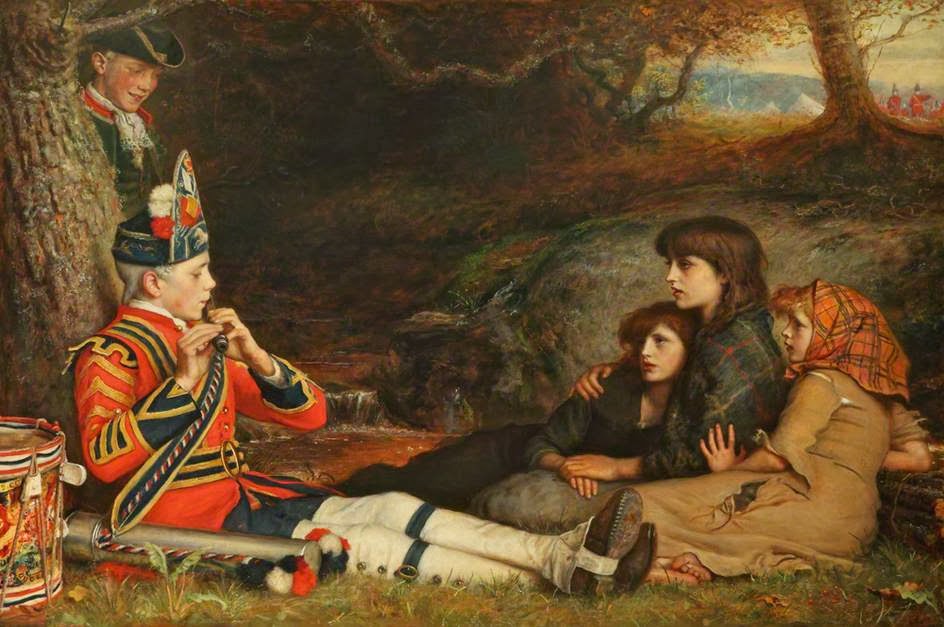
1745 Gallery by John Everett Millais


Bonnie Prince Charlie's 1745 expedition to reclaim the British crown for his father has captured the imagination of British artists for years.  One artist who painted 2 paintings of this era is John Everett Millais.  Millais's paintings are not focused on the statesmen who guided whole countries in this monumental event.  Nor are they battle panoramas, showing the desperate heroism of charging Jacobites and the immovable red coated British.  Instead, these two painting capture something different.  In "An Idyll of 1745" three lasses listen as a young British fifer plays to them.  Behind the fifer is a Loyal volunteer, seemingly enjoying the moment.  In the background is a British Army camp, likely where the fifer and volunteer came from.  It seems to be a welcome diversion for all from the business of war.


The next painting deals with the aftermath of the Battle of Culloden.  An imprisoned Jacobite has been released and allowed to return home to his wife and bairn (young child).  However, he is not without scars as his right arm has been badly injured.  The British soldier gives the wife the "Order of Release", the title of the painting.

Millais's two paintings are in honor of the civilians of 1745.  The war affected them, no matter which side won.  Homes were burnt, crops destroyed or stolen, and loved ones maimed or killed.  They show the friendship between the two sides of the rising, that despite political differences, love and friendship can transcend them.

"But love ye your enemies, and do good, and lend, hoping for nothing again; and your reward shall be great, and ye shall be the children of the Highest: for he is kind unto the unthankful and to the evil."--Luke 6:35

Tuesday, April 16, 2013

Major Gillies MacBean

Today is the anniversary of the Battle of Culloden.  Culloden was a decisive defeat for Bonnie Prince Charlie's Jacobites.  But even in defeat, there were heroes.

Painting from http://www.military-art.com/mall/more.php?ProdID=933


"Icy rain adds its misery to the bitter conflict on Drumossie Moor. In the shadow of the Black Isle, two English ships on the waters of the Moray Firth, await the outcome of the decisive battle. Pounded by Cumberland's gunners and raked by steady musketry, the Princes brave men can make no headway. Although the Irish and French regulars refuse to give ground, the Jacobite lines gradually disintegrate. Tired, cold and hungry men flea past Culloden House for the relative safety of Inverness. On the Scottish right the Argyll Militia, supported by Hawley's Dragoons, tear down the walls of the Culwiniac and Culchunaig enclosures in an outflanking attack. Avochie's men offer some resistance but Major Gillies McBean stands alone on the breach. He cuts down more than a dozen Argylls, including Lord Robert Kerr, who lies mortally wounded, but his foes are too many. The hero eventually falls to a vicious cut to the forehead, his thigh bone is also broken. Despite the cries of a mounted officer to save that brave man, the major is ruthlessly bayonetted, his back against the wall. The victory is complete and nothing more can be done. In the distance, the Young Pretender is forced to abandon the field and Scotlands hope of claiming the British Throne." from http://www.military-art.com/mall/more.php?ProdID=933

Friday, July 27, 2012

Mercy at Prestonpans


Prince Charles and his Highland army cheering after the Battle of Prestonpans.  
A captured cannon can be seen in the foreground

So inconceivably rapid was the onset, that the Camerons and Stewarts of Appin on the extreme left had swept over Whitefoord's artillery before he had time to fire more than five hasty rounds.  The guard, overwhelmed in the wave of tartan, made a brief stand behind the guns and then fled for their lives, leaving the two brave officers, Lieutenant-Colonel Whitefoord and Major Griffith, to the mercy of the enraged Celts.  Griffith was severely wounded and made prisoner, Whitefoord alone remained at his post, and when asked by Stewart of Invernahyle to surrender, made a desperate lunge at his antagonist with his sword by way of answer.  Invernahyle adroitly caught the point of the weapon in his targe, and in another instant Whitefoord would have met his fate at the hands of Invernahyle's stalwart miller, who seeing his laird in danger raised the Lochaber-axe he was carrying to cut down the obstinate Lowlander, but fortunately for that officer, Invernahyle was able to restrain his excited clansman, and Whitefoord seeing the utter futility of further resistance yielded to his magnanimous preserver."
"Whitefoord did not forget his obligation to Invernahyle, and after Culloden, when that chieftain was a fugitive among the hills, the brave colonel made the most strenuous efforts to secure his pardon, threatening to resign his commission if a protection was not granted for the lives and property of his preserver's wife and children.--Vide Introduction to "Waverley."
from pg. 98, volume 2, Life and Adventures of Prince Charles Edward Stuart by W. Drummond Norie

Monday, April 16, 2012

Royal Ecossais at Culloden


Today marks the Battle of Culloden, the battle that ended the Jacobite Rising of 1745. After a lengthy campaign, the Duke of Cumberland brought the Jacobites to battle at Culloden Moor. Bonnie Prince Charlie, the Jacobite leader, ordered his men to stand and fight. His right wing charged and smashed Barrell's 4th and Monro's 37th, but was decimated in a counter-attack by more British infantry. The Jacobite left did not charge and withdrew at the same time the survivors from the right wing fled. All the Jacobites were fleeing for Inverness. Cumberland's cavalry was brought up, ready to cut many of the Highlanders down...


Illustration by the author

In God's Providence, the French had sent two regiments to support him: Royal Ecossais (in English Royal Scots) and detachments from the Irish Brigade. The Royal Ecossais was in reserve at Culloden, and valiantly covered the retreat. They distracted the cavalry and saved many Jacobites from being cut down. One battalion of the Royal Ecossais was captured, but the other escaped.


The captured battalion was exchanged for captured British soldiers and the Royal Ecossais served gallantly for several more years until they were disbanded in 1762.

Thursday, February 16, 2012

Rout of Moy


Today (actually tonight and early tomorrow morning) marks the Rout of Moy, one of the most impressive instances of "One man of you shall chase a thousand" (Joshua 23:10a).


In 1746, Prince Charles Edward Stuart a.k.a. "Bonnie Prince Charlie" was staying at Moy Hall, the house of Lady Anne Farquharson-Mackintosh. Lord Loudoun heard of this, and set out to capture Bonnie Prince Charlie with 1,500 soldiers of the Independent Companies and his own 64th Highlanders. They marched by night to keep this attack a secret. However, fifteen year old Lauchlin Mackintosh ran from Inverness to Moy Hall to warn Lady Mackintosh that Charles was in danger.


When she heard the news, Lady Mackintosh sent the Prince away with thirty men. She had already assigned four men under Donald Fraser, blacksmith, to watch the roads to Moy Hall. When Loudoun's force came along, the five could see it. Fraser tried a daring ruse to delay Loudoun's men. He fired his gun and shouted for the MacDonalds and Camerons to charge while the other four discharged their muskets. Loudoun's men fled in terror, believing that they had run headlong into the main Jacobite army. The blacksmith was known ever after by the nickname of "Captain of the Five".


Following this rout, Loudoun and his force fled across the Spey River, leaving Inverness in Jacobite hands. The Jacobites would use Inverness as their base until they were destroyed at Culloden.


For Loudoun's report of the battle, see W. Drummond Norie, Life and Adventures of Prince Charles Edward Stuart, volume 3, pages 102-106

Thursday, January 12, 2012

Be Vigilant


Be sober, be vigilant; because your adversary the devil, as a roaring lion, walketh about, seeking whom he may devour:--1 Peter 5:8


"When in 1745 Charles Edward, the Young Pretender, marched southward after the capture of Edinburgh, an army under Sir John Cope advanced from Dunbar to stop his progress. This force had reached the neighbourhood of Haddington without having encounted the Prince and his Highlanders, and as Sir John became impatient to learn their whereabouts, he sent forward two scouts from the Edinburgh Volunteers. But these two faithless warriors never returned. Afterwards it was reported that they entered a tavern, where they became oblivious to their military duties over some sherry and oysters, and while they were in a drunken condition the scouts were captured by a mere lad, an attorney's clerk (emphasis his)."--A History of the Scottish People, volume 6, by Rev. Thomas Thompson.

Wednesday, September 21, 2011

The Battle of Preston Pans


Today is the anniversary of the Battle of Preston Pans, the greatest of all Jacobite victories in the Jacobite Rising of 1745.


When "Bonnie Prince Charlie" landed in Scotland to reclaim the throne for his father, James III (whose supporters were known as Jacobites), the Highland clans quickly formed an army for him. George II sent General Sir John Cope to stop this "Young Pretender". After almost fighting a battle in the Correyaireck Pass, Cope retreated to the Lowlands. Charlie and his army followed, and captured Edinburgh. General Cope was too late to save Edinburgh, but he set up his army on Preston Pans.


Charlie was ready for a battle, so his Jacobites moved to Preston Pans too. That evening, the armies kept rearranging for battle. In the morning, a thick fog covered the battlefield. The Highlanders charged through the fog and, missing the infantry in the middle, routed the dragoons on the flanks of the enemy. With their flanks open, the British infantry was rolled up by the wild, sword-swinging Highlanders in less than fifteen minutes. The first major conflict of the Jacobite Rising of 1745 was a huge victory for the Jacobites. General Cope actually brought the news of his own defeat, unlike his valiant subordinate Colonel Gardiner, who died in battle while leading seventeen soldiers who remained on the battlefield. The battle is celebrated in the song, Hey Johnny Cope, Are Ye Waulkin' Yet?


Following this battle, Charles and his army had much of Scotland to themselves. They enlarged the Jacobite army, until they daringly marched into England.

Friday, September 2, 2011

Beatrix Jenkinson


"If it be possible, as much as lieth in you, live peaceably with all men"--Romans 12:18


Picture from www.battleofprestonpans1745.org From left to right: Mary Jenkinson, Charles Edward Stuart, Beatrix Jenkinson.


Beatrix Jenkinson is relatively unknown. I have not yet found the date of her birth, death, or marriage (supposing she was married). She appears for a short time on the stage of history and disappears just as suddenly, leaving behind a reputation for kindness.


One thing that is known is that she had at least one sister named Mary and one brother. Her father was minister at Tranent Church in Scotland. In the year 1745, Bonnie Prince Charlie landed in Scotland to reclaim the crown of England, Scotland, and Ireland for the Stuarts. He raised an army of Highland Scots and marched on Edinburgh, which was defended by General Sir John Cope. On his march, Prince Charles stopped at Duddingston, where he met Beatrix and Mary Jenkinson. He called them the "bonniest lassies I have seen in Scotland".


On September 21, Charlie finally brought General Cope's army to battle at Preston Pans. In fifteen minutes the British were routed, with General Cope running for dear life. Only his subordinate Colonel James Gardiner continued the battle until he was wounded with a Lochaber axe. Colonel Gardiner was carried to Tranent Church and cared for by Beatrix Jenkinson until he died on the morning of September 22.


This, then, is all that is known of Miss Jenkinson, who met Prince Charles and cared for his enemy, Colonel Gardiner.

Thursday, July 7, 2011

Lady Anne (Livingston) Boyd, Countess of Kilmarnock

General Hawley receiving the messenger informing him of the Jacobite march. The messenger is, unfortunately, incorrect, having a 1750s light dragoon helmet. Picture by the author.


And Jael went out to meet Sisera, and said unto him, Turn in, my lord, turn in to me; fear not--Judges 5:15a


"She was a woman of splendid pers and manners; and Hawley, completely fascinated by her well-acted blandishments, spent the whole of this important forenoon in her company, without casting a thought upon his army"--Robert Chambers, historian


When Charles Edward Stuart a.k.a. "Bonnie Prince Charlie" landed in Scotland in 1745, William Boyd, Earl of Kilmarnock, joined him with a troop of Horse Grenadiers. When the Horse Grenadiers gave up their horses, Kilmarnock turned them into the Footguards.


After retreating from England, the Jacobites besieged Stirling Castle. British General Henry Hawley gathered an army to relieve Stirling. The Jacobites took up a position near Falkirk, but there was some danger that Hawley would strike before they were fully deployed.


The Countess of Kilmarnock solved the dilemma by inviting General Hawley to breakfast. Hawley apparently enjoyed himself, for he stayed until the battle began around 1 P.M.; then he departed in haste, taking her napkin and forgetting his hat (see author's illustration above).


Charles's Jacobites defeated Hawley's soldiers, and the Battle of Falkirk was a victory for the Prince. However, Lady Kilmarnock had made a very important contribution.


She died September 16, 1747, after the execution of her husband, Lord Kilmarnock.


Lord and Lady Kilmarnock from Panel #43 of the Prestonpans Tapestry

Tuesday, May 3, 2011

Flora MacDonald

Blessed are the merciful, for they shall obtain mercy--Matthew 5:13


Miss Flora MacDonald (1722-1790) ferried "Bonnie Prince Charlie" to the Isle of Skye. After the Battle of Culloden, Prince Charles fled through Scotland. He was on the west coast of Scotland, and the British were hunting for him. Captain O'Neil, one of Charles's companions, enlisted the help of Flora MacDonald to sail the Prince from the mainland to Skye. Flora disguised the Prince as her maid, Betty Burke, and sailed for the island. Prince Charles reached Skye, and with the help of French ships, regained the Continent. Flora MacDonald was arrested, but not punished. She later married, emigrated to the British colonies, and encouraged the 84th Royal Highland Emigrants during the American War for Independence. She died in 1790, and has been highly praised by many.


"Miss Flora is about twenty four years of age, of a middle stature, well shaped, a very pretty agreeable person, of great Sprightliness in her Looks, and abounds with good Sense, Modesty, Good-nature, and Humanity."--John Burton, contemporary of Flora MacDonald

Tuesday, February 8, 2011

Lady Anne Farquharson-Mackintosh


(Engraving of Lady Mackintosh based on painting by Allan Ramsay, found in Life and Adventures of Bonnie Prince Charlie volume 3 by W. Drummond Norie)

One man of you shall chase a thousand: for the Lord your God fighteth for you, as he hath promised you--Joshua 23:10


Lady Mackintosh giving final instructions just before the rout of Moy (drawing by the author).

The noble lady I chose for the month of February is Lady Anne Farquharson-Mackintosh. When Prince Charles Edward Stuart, a. k. a. "Bonnie Prince Charlie" landed in Scotland in 1745 to rally Jacobites for one last attempt to regain the crown of his forefathers, Lady Anne raised the members of Clan Mackintosh and the Chattan Confederation (of which the Mackintoshes were chief) for the Prince. The new regiment was dubbed Lady Mackintosh's Regiment, and she received the title of "Colonel" Anne. But this was not the only contribution of Lady Mackintosh to the Jacobites

"Bonnie Prince Charlie" was staying at Lady Mackintosh's house named Moy Hall when she received word that the enemy commander, Lord Loudon, was marching with two thousand men to capture the Prince. Lady Mackintosh sent the Prince away while she formed a distraction. To quote Fitzroy Maclean, historian,


"She had, with great presence of mind, sent the blacksmith of Moy, one Donald Fraser, and four others to take up a position 'upon a muir, at some distance from Moy, towards Inverness, and there await the approach of Lord Loudon's men." (read more about the rout of Moy from Mr. Maclean here).
In the darkness, the five men hid until Loudon's force approached. Then the five fired and shouted Highland war cries. Lord Loudon and his men believed that they had stumbled into an army, and fled for Inverness. The Prince was saved and the enemy humilated in what became known as "The Rout of Moy".